A 26-year-old male from the Far Western Region of Nepal presented at the teaching hospital of Kathmandu with erythematous and blackish crust over the upper lip. He noticed the lesion 6 months ago. It was painful and did not heal with the over-the-counter antibiotic ointment.
He then came to Kathmandu in search of a tertiary care center. The crust was removed, and oozing fluid was touched on a slide and sent for cytological examination. Under microscopy, dense parasites were observed, and these were Leishmania parasites. The rK39 strip test was also positive.
He was treated with a drug provided by the government of Nepal at no cost, and now the lesion is completely healed.
What is Leishmaniasis?
Leishmaniasis, also known as Kala-azar, is a disease caused by a tiny parasite (Leishmania donovani) that spreads to humans through the bite of infected sandflies. This comes under Neglected Tropical Diseases, a concern of public health worldwide. This disease is endemic to the districts, mainly in the Terai belt in Nepal; however, as new case reports from previously non-endemic eastern and western hilly regions of Nepal are a rising concern. This seems challenging to the Nepal government, which has set a goal to eliminate the disease as a public health problem by 2026, with the annual incidence of <1 case/10,000 population at the district level.
One possible reason for this shift is global warming, which may be allowing sandflies to survive and spread in areas that were previously too cold for them. Changes in temperature, rainfall, and human movement may all be contributing to this emerging pattern.
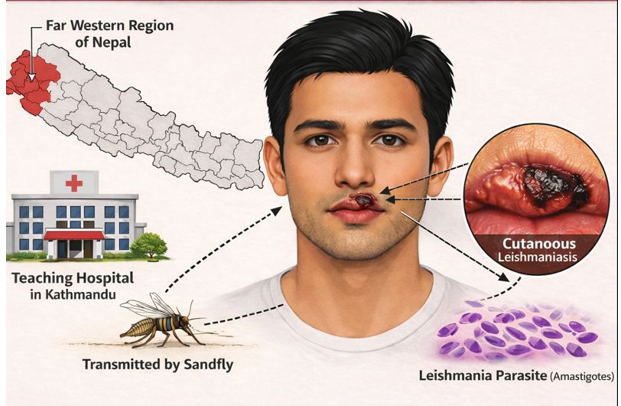 Image: Schematic diagram showing A 26-year-old male with erythematous and blackish crust over the upper lip (image prepared with the help of ChatGPT)
How to prevent Leishmaniasis?
Early recognition and treatment are very important. Any long-lasting skin or mucosal lesions should be evaluated for parasitic infestation. A blood serum test, the rK39 strip test, is easily available and free of cost from our government. Smearing of oozing fluid, fine needle aspiration can be done without a surgical procedure, or a biopsy can be taken.
Treatment is drug therapy and is also free from the Government. Preventive measures such as using bed nets, wearing protective clothing, and reducing sandfly breeding sites around homes can help reduce the risk. Increasing public awareness is essential to prevent delayed diagnosis and to limit the spread of this emerging disease in Nepal.
[Dr. Kafle is an assistant professor/pathologist at Tribhuvan University Teaching Hospital and frequently writes articles for public health awareness on various diseases.]